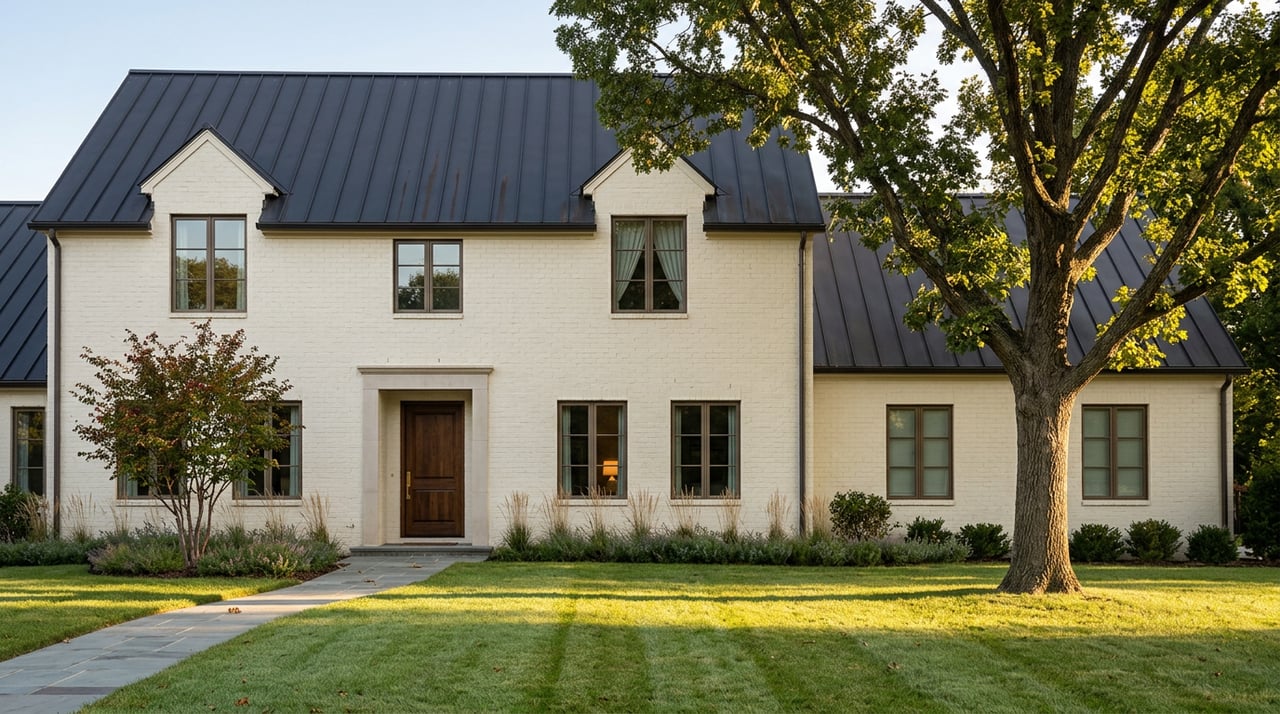
Why Cherry Hills Village Home Prices Start With Lot Value
August 6, 2026
August 6, 2026
Pull five reports on the Cherry Hills Village market from the last four months and you get five different answers. The median sale price sits at $2.2 million in one, $3.8 million in another, $4 million in a third, and $5 million in a fourth. Each source is sourcing MLS data. None of them is wrong. All of them are misleading if you read the number the way you would read a median in Wash Park or the Highlands.
The reason is small-sample math meeting a market where lot size, not square footage, is the underlying asset. Once you see the mechanism, the shopping process changes.
| Source | Window (2026) | Median | $/sf | Days on Market |
|---|---|---|---|---|
| Summit Colorado Realty | February | $2,205,000 | $454.70 | 117 |
| Zillow ZHVI | April 30 | ~$3,245,000 | — | — |
| Redfin | 3 mo. ending May | $3,800,000 | $580 | 8 |
| Orchard | 30-day, June | $4,000,000 | $592.89 | 10 |
| Realtor.com | March | $4,222,500 (list) | — | 41 |
| Movoto | April | $5,000,000 (list) | $637 | 46 |
Six sales closed in Cherry Hills Village in February 2026. Seven closed in the 30 days Orchard measured. Redfin counted 40 in the three months ending May, and 12 in March alone. When a city closes fewer than a dozen homes in a month and one of them trades at $9.75 million, as 11 Cherry Hills Drive did on March 19, 2026, the median moves five to seven figures based on which house happened to close. The $4.999 million sale at 1515 E Tufts on March 20, 2026 does the same. You are not reading a market temperature. You are reading which houses were on the closing calendar that week.
Cherry Hills Village is roughly 6.2 square miles and holds about 2,400 single-family homes. Zoning tiers explain more of the price dispersion than any market cycle. Chapter 16 of the municipal code sets R-1 lots at 2.5 acres or larger, R-2 at 1.25 acres, R-3 at 1 acre, and R-3A at 16,000 square feet minimum with averages closer to 29,000. A house on a conforming R-3A parcel and a house on an R-1 estate parcel are, functionally, two different products sold under the same city name.
The city has been protecting that structure actively. In 2025 the council adopted Ordinance 7, an emergency moratorium on new subdivision applications, which is listed in the city's ordinance archive. Combined with a 97 percent owner-occupancy rate and a build-out condition on virtually every buildable acre, the supply side is closer to fixed than any comparable Denver-metro market. Land is the scarcity. In most Cherry Hills Village transactions, the parcel represents 40 to 60 percent of the total value, and price per square foot on the improvements above it tells you far less than acreage, orientation, tree cover, and pocket.
That is the number the portals cannot show. It is also the reason the same $3.2 million buys a fully renovated one-acre home on the Belleview corridor or a scrape candidate on 2.5 acres three streets away.
The most common mistake at the lower end of the market is treating a $1.8 to $2.5 million ranch as a move-in home when the surrounding streetscape is telling you it is a redevelopment parcel. The city's rules make that distinction sharp and expensive to miss.
Chapter 9 of the zoning code treats a project as redevelopment when demolition or floor-area increase crosses roughly 50 percent of aggregate floor area. Crossing that threshold pulls a project into a heavier review track. Below it, you are renovating. Above it, you are effectively building new, on the city's terms.
For a buyer running the math on an older home, the friction stacks in a predictable order:
None of this is prohibitive. It is expensive to underestimate. A $2.1 million "entry" home whose realistic path forward is a scrape reads very differently once the ARC calendar, the 40-degree bulk plane, and a Phase III drainage plan are on the same spreadsheet as the acquisition price.
Two homes at the same list price in Cherry Hills Village can carry six-figure gaps in build-out cost before either buyer signs a construction contract. The list price is a starting line, not a comparable.
Reading Cherry Hills Village as one market compounds the median problem. Old Cherry Hills, Charlou, Cherry Hills Farm, Cherry Hills Park, the guard-gated Buell Mansion enclave, and The Villas at Cherry Hills each trade on different logic. The Belleview corridor, the northern gateway of the city, is the most active scrape-and-rebuild zone, with developers acquiring older ranches in the $1.5 to $2 million range and delivering new construction listing in the $3.5 to $5 million-plus band. Cherry Hills Park is seeing similar activity on premium interior lots. Old Cherry Hills, closer to the country club, held only around five active listings in early spring, which means one aged listing or one aggressive comp resets the local reference points for months.
Absorption is uneven inside these pockets. Altos Research showed 26 to 43 percent of active listings carrying price reductions through the spring, and active listings aging past 70 days while sold homes moved in a Redfin-measured median of eight days in May. The read from that spread is not that the market is hot or soft. It is that well-priced homes on strong parcels transact quickly, and aspirational pricing sits regardless of segment. A single citywide median cannot hold both truths at once.
If you are shopping seriously in Cherry Hills Village this year, three moves protect you from the median illusion:
The Cherry Hills Country Club calendar, the 71-mile High Line Canal Trail, Quincy Farm, and the semi-rural feel that pulls buyers here have not changed. What changes each quarter is which handful of estates happens to close and how loudly that noise shows up on the aggregators.
Why do Zillow, Redfin, and Realtor.com show such different numbers for the same city? Different windows and different denominators. Redfin's three-month sold view smooths noise across roughly 40 closings. Orchard's 30-day view rests on 7. Zillow's ZHVI models typical value across the entire housing stock. Realtor.com reports list prices, not sold prices. Each is internally consistent. None of them is measuring the same thing.
Is the scrape-and-rebuild trend still active in 2026? Yes, particularly along Belleview and inside Cherry Hills Park, where 1960s and 1970s ranches on premium lots are being replaced with 6,000 to 10,000 square-foot new builds. The 2025 subdivision moratorium restricts creating new lots, but replacing structures on existing lots remains the dominant path to new construction.
How long does the Architectural Review Committee process actually take? Plan on two to four months for a substantial renovation or new build to move through review before permitting begins. Complex projects with variance requests can run longer.
What is the practical impact of the bulk plane rule? A 40-degree plane from side and rear setbacks limits how tall the outer edges of a home can rise. It tends to push design toward pitched roofs and stepped-back upper floors on wider footprints, which is worth understanding before you fall for a lot plan that assumes vertical space you cannot legally build.
Buying in a market this small rewards specificity over averages. If you are weighing a Cherry Hills Village home this year and want a read on what the list price actually implies for your build-out, carry cost, and long-term basis, Stephanie Watanabe is glad to walk the parcel with you. Let's connect.
Stay up to date on the latest real estate trends.
Whether you're buying your first home, selling a longtime property, or exploring your next investment, Steph Watanabe is committed to making the process seamless and rewarding. With local market expertise, personalized guidance, and a client-first approach, Steph takes the time to understand your goals and provide honest advice every step of the way.

STEPH WATANABE
4643 S Ulster Street Suite 500 Denver, CO 80237